[Q117-Q136] Latest Salesforce-MuleSoft-Developer-I Practice Test Questions Verified Answers As Experienced in the Actual Test!

Rate this post

Latest Salesforce-MuleSoft-Developer-I Practice Test Questions Verified Answers As Experienced in the Actual Test!

Pass Salesforce Salesforce-MuleSoft-Developer-I Exam in First Attempt Easily

NO.117 A Scatter-Gather processes three separate HTTP requests. Each request returns a Mule event with a JSON payload. What is the final output of the Scatter-Gather?


NO.118 As a part of requirement , application property defined below needs to be accessed as dataweave expression.
What is the correct expression to map it to port value?


NO.119 Refer to the exhibit.
How should the WHERE clause be changed to set the city and state values from the configured input parameters?


NO.120 Refer to the exhibit.

What should be changed to fix the 415 error?


NO.121 A Mule project contains a DataWeave module called MyModule.dwl that defines a function named formatString. The module is located in the project’s src/main/resources/modules folder.
What is the correct way in DataWeave code to import MyModule using a wildcard and then call the module’s formatString function?


NO.122 Refer to the exhibits.
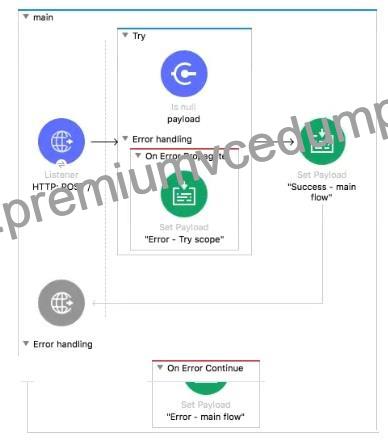
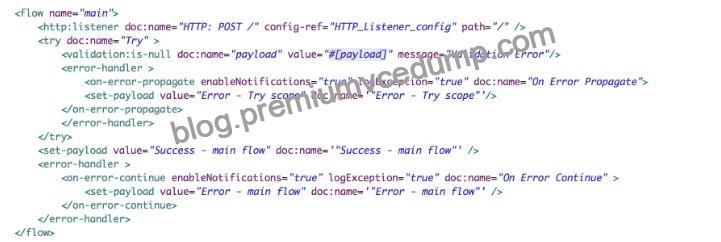
The Validation component in the Try scope throws an error.
What response message is returned to a client request to the main flow’s HTTP Listener?
The Validation component in the Try scope throws an error. What response message is returned to a client request to the main flow’s HTTP Listener?


NO.123 Refer to the exhibits.


The Batch Job scope contains two BatchStep scopes with different accept expressions.
The input payload is passed to the Batch Job scope.
After the entire payload is processed by the Batch Job scope, what messages have been logged by the Logger components?


NO.124 Which of the module is imported automatically in Dataweave scripts?


NO.125 Where are values of query parameters stored in the Mule event by the HTTP Listener?


NO.126 A Mule project contains a DataWeave module like WebStore.dwl that defines a function named loginUser. The module file is located in the project’s src/main/resources/libs/etl folder.
What is correct DataWeave code to import all of the WebStore.dwl file’s functions and then call the loginUser function for the login “[email protected]”?


NO.127 An On Table Row Database listener retrieves data from a table that contains record_id, an increasing numerical column.
How should the listener be configured so it retrieves new rows at most one time?


NO.128 An API specification is designed using RAML. What is the next step to create a REST Connector from this API specification?


NO.129 A Mule flow has three Set Variable transformers. What global data structure can be used to access the variables?


NO.130 Refer to the exhibit.

What is the output payload in the On Complete phase


NO.131 Refer to the exhibit.


The main flow is configured with their error handlers. A web client submit a request to the HTTP Listener and the HTTP Request throws an HTTP:NOT_FOUND error.
What response message is returned?”
What response message is returned?


NO.132 Which of the below is not a valid category for connector type?


NO.133 A
web client submits a request tohttp://localhost:8081/books/0471767840. The value
“0471767840” is captured by a Set Variable transformer to a variable named booklSBN.
What is the DataWeave expression to access booklSBN later in the flow?


NO.134 A Database On Table Row listener retrieves data from a CUSTOMER table that contains a primary key userjd column and an increasing kxjin_date_time column. Neither column allows duplicate values.
How should the listener be configured so it retrieves each row at most one time?


NO.135 Refer tothe exhibits.


The Batch job processes an array of strings.
What information is logged by the logger component after the batch job scope completes processing of the input payload?


NO.136 Refer to the exhibit.

What is a valid expression for the Choice router’s when expression to route events to the documenticShipping flow?


Salesforce Salesforce-MuleSoft-Developer-I Exam Syllabus Topics:

Topic Details
Topic 1
  • Building API Implementation Interfaces: This topic involves manually creating a RESTful interface for a Mule application and generating a REST Connector from a RAML specification. It also includes describing the features and benefits of APIkit.
Topic 2
  • Debugging and Troubleshooting Mule Applications: Using breakpoints to inspect a Mule event during runtime, installing missing Maven dependencies, and reading and deciphering Mule log error messages are sub-topics of this topic.
Topic 3
  • Creating Application Networks: The topic of creating Application Networks encompasses understanding MuleSoft’s proposal for closing the IT delivery gap and describing the role and characteristics of the modern API. It also includes the purpose and roles of a Center for Enablement (C4E), and the benefits of API-led.
Topic 4
  • Using Connectors: It focuses on retrieving data from REST services using HTTP Request or REST Connector. Moreover, the topic covers using a Web Service Consumer connector for SOAP web services and the Transform Message component.
Topic 5
  • Transforming Data with DataWeave: It involves writing DataWeave scripts and using DataWeave functions. This topic also includes defining and using DataWeave variables, functions, and modules, and applying correct syntax.
Topic 6
  • Routing Events: It focuses on using the Choice router for conditional logic and the Scatter-Gather router to multicast events. This topic also involves validating data by using the Validation module.
Topic 7
  • Structuring Mule Applications: Structuring Mule applications covers parameterizing an application and defining and reusing global configurations. It includes breaking an application into multiple flows using private flows, subflows, and the Flow Reference component.
Topic 8
  • Processing Records: Processing records includes methods for processing individual records in a collection and explaining how Mule events are processed by the For Each scope. It also involves using the Batch Job with Batch Steps and a Batch Aggregator.
Topic 9
  • Accessing and Modifying Mule Events: It describes the Mule event data structure. Moreover, the topic focuses on usage of transformers and enriching Mule events.
Topic 10
  • Deploying and Managing APIs and Integrations: It includes packaging Mule applications for deployment and deploying them to CloudHub. This topic also involves using CloudHub properties, creating and deploying API proxies, connecting an API implementation to API Manager, and applying policies to secure an API.


We offers you the latest free online Salesforce-MuleSoft-Developer-I dumps to practice: https://www.premiumvcedump.com/Salesforce/valid-Salesforce-MuleSoft-Developer-I-premium-vce-exam-dumps.html

Related Links: myportal.utt.edu.tt myportal.utt.edu.tt myportal.utt.edu.tt myportal.utt.edu.tt www.stes.tyc.edu.tw www.stes.tyc.edu.tw